- Home
- Simple Diet
- Foods With No Carbs
Foods with No Carbs:
A Practical Food List
Plain beef, pork, chicken, fish such as salmon and cod, pure cooking oils, and water are good starting points when you're looking for foods with no carbs. Eggs, cheese, and cream have small amounts, even though you'll often see them on zero-carb food lists.
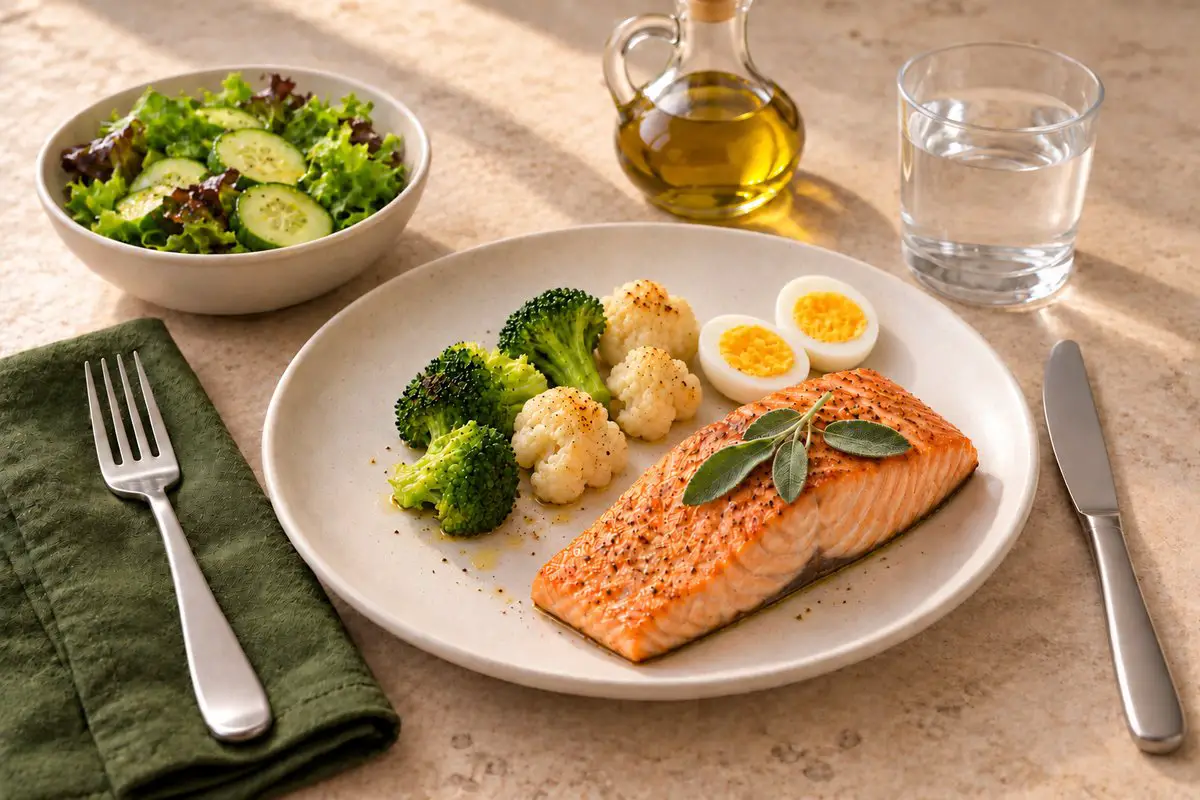
I put this guide together to help you choose foods and plan meals without having to guess. Below you'll find a zero-carb list, the amounts in familiar nearly carb-free foods, and a few things to watch for at the grocery store.
Zero-carb food list
Each food below has 0 grams of total carbs in the USDA food data I checked. These numbers are a useful guide, although individual products can vary. Each food links to its source.
Choose the plain versions. Breading, sweet sauces, and glazes can add carbs to an otherwise carb-free piece of meat or fish.
| Food | Amount | Total carbs |
|---|---|---|
| Ground beef, 90% lean, raw | About 3.5 oz (100 g) | 0 g |
| Pork tenderloin, boneless, raw | About 3.5 oz (100 g) | 0 g |
| Chicken breast, roasted, meat only | 3 oz (85 g) | 0 g |
| Atlantic salmon, farmed, raw | About 3.5 oz (100 g) | 0 g |
| Atlantic cod, baked or roasted | 3 oz (85 g) | 0 g |
| Light tuna, canned in water, drained | 3 oz (85 g) | 0 g |
| Atlantic sardines, canned in oil, drained | 3 oz (85 g) | 0 g |
| Olive oil | 1 tbsp | 0 g |
| Avocado oil | 1 tbsp | 0 g |
| Canola oil | 1 tbsp | 0 g |
| Ghee (clarified butter) | About 1 tbsp | 0 g |
| Plain water | 1 cup | 0 g |
| Brewed coffee, without additions | 1 cup | 0 g |
| Brewed green tea, unsweetened | 1 cup | 0 g |
The amounts help you compare foods; they aren't instructions for how much to eat. With packaged fish, check the sauce or flavoring as well as the fish itself.
Foods often mistaken for zero-carb
Eggs, butter, cheese, and cream can fit a low-carb meal without being completely carb-free. Some contain only tiny amounts, often called "trace carbs." Others contribute more as the portion gets bigger.
These are approximate total carb counts, including fiber. For packaged foods, check your brand's label too.
| Food | Amount | Total carbs |
|---|---|---|
| Hard-boiled egg | 1 large egg | 0.6 g |
| Butter, salted | 1 tbsp | Less than 0.1 g |
| Heavy cream | About 1 tbsp | 0.6 g |
| Cheddar cheese | 1 oz | 0.7 g |
| Camembert cheese | 1 oz | 0.1 g |
| Parmesan cheese, hard | 1 oz | 0.9 g |
| Shrimp, cooked | 3 oz (85 g) | 0.2 g |
| Mayonnaise, regular | 1 tbsp | 0.1 g |
| Yellow mustard, prepared | 1 tsp | 0.3 g |
| Green olives, pickled | 5 olives (about 14 g) | 0.5 g |
| Brewed black tea, unsweetened | 1 cup | 0.7 g |
| Espresso, restaurant-prepared | 1 fl oz | 0.5 g |
| Ground cinnamon | 1 tsp | 2.1 g |
| Balsamic vinegar | 1 tbsp | 2.7 g |
Eggs, cheese, and cream
A hard-boiled egg contains roughly half a gram of carbs. That's a small amount, and it doesn't make eggs a poor low-carb choice.
With cheese, both the type and the portion matter. A slice, a thick chunk, and a handful of grated cheese can be very different amounts. The Parmesan entry above is for hard cheese; packaged grated versions may differ.
Cream is easy to underestimate when you pour it straight into a mug. The USDA amount above works out to about 2.3 grams of carbs in a quarter cup, compared with about 0.6 grams in a tablespoon. Brands vary, so check the carton you use.
Seafood: shrimp isn't the same as oysters

Don't assume all seafood has the same carb count. For a 3-ounce portion, USDA examples show about:
- 0.2 g for the cooked shrimp listed above.
- 2.3 g for raw Eastern wild oysters.
- 6.3 g for cooked blue mussels.
- 12.8 g for imitation crab made from surimi.
Organ meats need a separate check too. For example, raw beef liver has about 3.3 grams per 3 ounces. A zero-carb count for a plain cut of beef doesn't apply to every part of the animal.
Seasonings and drinks

A pinch of cinnamon has much less carbohydrate than the full teaspoon in the table. You don't need to count a sprinkle as a spoonful. But seasonings aren't automatically carb-free.
Vinegar varies too: distilled vinegar has less than 0.1 grams per tablespoon, while balsamic has noticeably more.
The drink entries show why it helps to name the drink: brewed coffee, espresso, green tea, and black tea have different USDA values. Count milk, cream, sugar, and syrups separately.
Why a label can say zero when there are some carbs
A zero on the label can mean a tiny amount, rather than none at all. On U.S. Nutrition Facts labels, an amount below half a gram of carbs per serving can be rounded down to 0 g. FDA labeling rule
Small amounts can add up when you use several servings. If a cream or dressing lists one tablespoon as a serving, a generous pour may be several times that amount.
I would check serving size and Total Carbohydrate together. Compare the serving on the package with what actually goes into your cup or onto your plate.
What about "zero net carbs" or "sugar-free"?
Those don't necessarily mean zero total carbs. Total carbohydrate includes fiber as well as sugars and sugar alcohols. Net-carb claims generally subtract fiber and may subtract other carbs; sugar-free foods can still contain other kinds of carbs. FDA explanation of total carbs
This guide uses total carbs throughout. To compare a package with the tables, start with its Total Carbohydrate line.
Packaged foods worth a closer look
Here are the products I would check most carefully:
- Bacon, sausage, deli meats, and jerky: Sugar, starches, and other ingredients can change the carb count. Check the finished product.
- Marinated meats and breaded fish: The plain-food numbers won't include the coating or sauce.
- Dressings, mayonnaise, mustard, and hot sauce: Brands and sweetened versions differ. Check how much the label calls one serving.
- Cheese spreads, flavored dairy, and seasoning blends: Added ingredients can bring added carbs.
- Sweetener packets and baking blends: Zero calories doesn't necessarily mean zero carbs. For example, Splenda Original packets include dextrose and maltodextrin along with sucralose.
- Keto breads, tortillas, bars, and sweets: Check whether the prominent number is total carbs or net carbs.
The ingredient list helps explain where carbs come from. The Nutrition Facts panel tells you the amount listed for that product and serving.
Are there any zero-carb vegetables?
Ordinary whole vegetables contain some carbs, including fiber. Lettuce, spinach, and cucumber can be low-carb choices, but they aren't carb-free.
For example, USDA data shows approximately:
- Butterhead lettuce, raw: 1.2 g per cup, chopped or shredded.
- Baby spinach: 0.7 g per roughly 1 oz (30 g).
- Cucumber with peel, raw: 3 g per 3.5 oz (100 g).
You don't need to avoid a vegetable just because its carb count is above zero. If you're tracking carbs, include the portion you eat in your count.
Whole olives contain carbs too, even though pure olive oil has a zero-carb entry in the first table.
What are some no-carb or nearly carb-free snacks?
For a simple snack, try plain cooked chicken, drained tuna, or sardines. Check any sauce or dressing you add.
Hard-boiled eggs and cheese are convenient nearly carb-free options. Two large hard-boiled eggs contain about 1.1 grams of total carbs.
Plain pork skins also have a zero-carb USDA entry. Seasoned versions need a label check. Carb content doesn't tell you everything about a snack's calories, sodium, or other nutrients.
Will eating zero-carb foods help me lose weight?
These foods can help you cut back on carbs, but zero carbs doesn't mean zero calories or guaranteed weight loss. Oils and other fats still add calories, so portions matter.
NIDDK's weight-loss guidance recommends a reduced-calorie eating plan that suits your health needs and preferences and that you can maintain over time.
I would use this list to help plan meals and compare foods. You don't have to make every meal as close to zero carbs as possible. Consider the food's other nutrients and your overall eating habits too.
If you're following a medically prescribed diet, use the carb targets your clinician has given you.
A simple grocery checklist
Take this list to the store. I've put the essentials on one printable page, with shopping checkboxes, common near-zero foods, and a quick label reminder.
Print or save the grocery guide (PDF)
1 page | US Letter | Opens in a new tab
Here's how I would organize the list for a shopping trip:
- Plain meat and fish: Beef, pork, chicken, salmon, cod, canned tuna, and sardines.
- Cooking fats: Olive oil, avocado oil, canola oil, or ghee.
- Drinks: Water, plain brewed coffee, and unsweetened green tea.
- Nearly carb-free foods: Eggs, butter, cheese, cream, shrimp, mayonnaise, and mustard. Allow for their small carb counts.
- Low-carb produce: Lettuce, spinach, cucumber, and olives. Count your portions.
- Check before buying: Processed meats, sauces, flavored dairy, sweetener blends, and products advertised as zero net carbs.
Choose what fits your meals. A food doesn't have to contain exactly zero carbs to earn a place on your grocery list.
How I checked this list
I used USDA FoodData Central entries for the specific foods and preparations shown. Each linked food name opens a USDA search for that entry's record number.
Food data, portions, and sources
About the numbers: USDA values describe particular food samples or products, not every brand. Some are calculated or assumed. A reported zero doesn't prove that every sample contains absolutely no carbohydrate, and missing data aren't treated as zero. USDA methods
Portions and rounding: I calculated total carbs from USDA's amounts per 100 grams, using the edible portion and the raw or cooked state named. Raw and cooked weights aren't interchangeable. Most results are rounded to one decimal place; tiny positive amounts are shown as "less than 0.1 g," not zero. Larger-portion calculations use the unrounded figures.
Weights behind household measures: The calculations use 50 g per egg; 28.35 g per ounce of cheese; 14.2 g per tablespoon of butter; 15 g for cream and distilled vinegar; 13.8 g for mayonnaise; 16 g for balsamic vinegar; 5 g per teaspoon of mustard; 2.6 g per teaspoon of cinnamon; 13.5 g for five olives; and 55 g per cup of lettuce. Beverage cups are 237 g, and espresso is 29.6 g per fluid ounce. Oil portions are 13.5 g for olive oil and 14 g for avocado oil, canola oil, and ghee. Household measures are approximate; olive sizes vary.
Label rounding: FDA permits less than 0.5 g of total carbs per serving to appear as 0 g on a U.S. Nutrition Facts label. "Less than 1 g" is a separate labeling option, not the threshold for rounding to zero. A printed zero doesn't reveal the exact unrounded amount.
Data sources: I used the Foundation Foods April 2026 release and SR Legacy April 2018 release from USDA's dataset downloads, matching entries to the food and preparation. Release dates aren't individual testing dates. The nutrient used was "Carbohydrate, by difference," which includes fiber. Fiber hasn't been subtracted.
Sources
- USDA FoodData Central: individual food entries linked throughout, plus its data documentation.
- FDA: Total Carbohydrate, Nutrition Facts label guide, and carbohydrate rounding rule, 21 CFR 101.9(c)(6).
- NIDDK: Choosing a Safe and Successful Weight-loss Program.
- Splenda: Original Sweetener Packets, used only as an ingredient example.